

Chemistry challenges me to think critically, combining problem solving with understanding how reactions apply to real life and shape the world daily.
Sophie Aman
A Level, AQA
Course Description
Chemistry is the study of matter, analysing its structure, properties and behaviour to see what happens when substances combine or separate to form other substances. It also involves the study of how these chemicals interact with energy. Throughout the course, you will apply mathematical skills to solve chemical problems. You will develop your skills in problem-solving, analysis and the ability to understand complex data and abstract ideas.
Entry Requirements
APS 5.5 or above
GCSE English Language grade 4 or above
GCSE Mathematics grade 6 or above
66 or above in Combined Science or 6 or above in Chemistry
Where a 7 in Mathematics, 7 in Chemistry or 7-7 in Combined Science is secured, an APS below 5.5 will be considered.
Course Content
3.1 Physical Chemistry
Atomic structure, amount of substance, bonding, energetics, kinetics, chemical equilibria and Le Chatelier’s principle. Thermodynamics, rate equations, equilibrium constant for homogeneous systems, electrode potentials and electrochemical cells, acids, bases and buffers.
3.2 Inorganic Chemistry
Periodicity, Group 2 and Group 7. Properties of Period 3 elements and their oxides, transition metals, reactions of ions in aqueous solutions.
3.3 Organic Chemistry
Introduction to organic chemistry, alkanes, halogenoalkanes, alkenes, alcohols and organic analysis. Optical isomerism, aldehydes and ketones, carboxylic acids and derivatives, aromatic chemistry, amines, polymers, amino acids, proteins and DNA, organic synthesis, NMR spectroscopy and chromatography.
Assessment
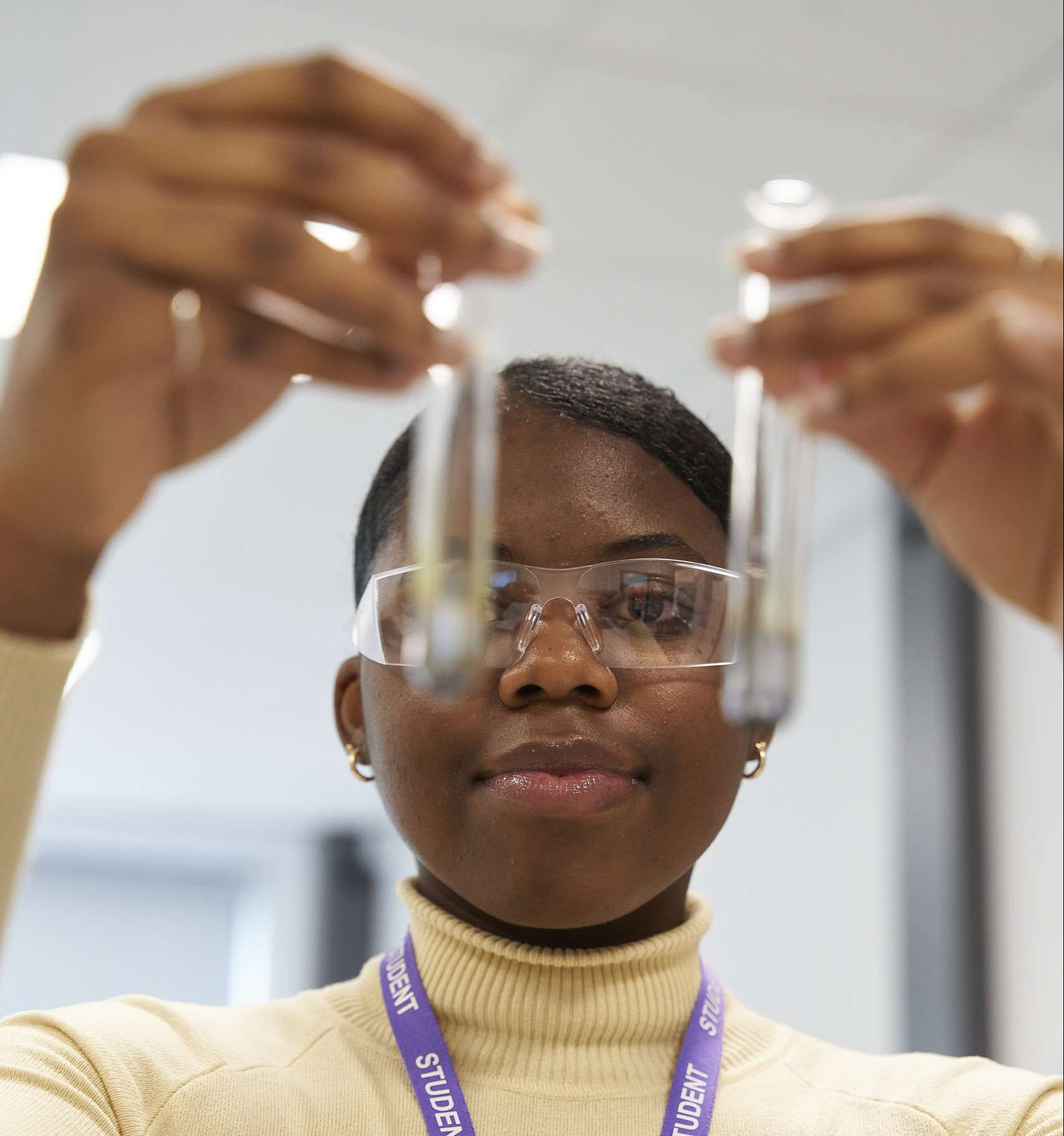
Over the 2 year course you will complete 12 Required Practicals during which your teacher assesses you for Practical Endorsement, which is useful for further study or employment in Sciences
Students will sit three two-hour written exam papers. The content, assessment and questions differ for these papers; please see the information below for more detail.
Paper 1:
Written exam: 2 hours
105 marks – a mixture of short and long answer questions
35% of A Level
Paper 2:
Written exam: 2 hours
105 marks – a mixture of short and long answer questions
35% of A Level
Paper 3:
Written exam: 2 hours
90 marks: 40 marks – structured questions, including practical techniques; 20 marks – testing across the specification; 30 marks – multiple choice questions
30% of A Level
A practical endorsement is part of the qualification, where your practical skills are assessed by your teachers during twelve practical activities.
Future Opportunities
Chemistry is a great choice of subject for people who want a career in health and clinical professions, such as medicine, nursing, biochemistry, dentistry, forensic science or veterinary science. It will also equip participants for a future career in industry, for example the petrochemical or pharmaceutical industries. Learners should always check the entry requirements for degree programmes with specific higher education providers.